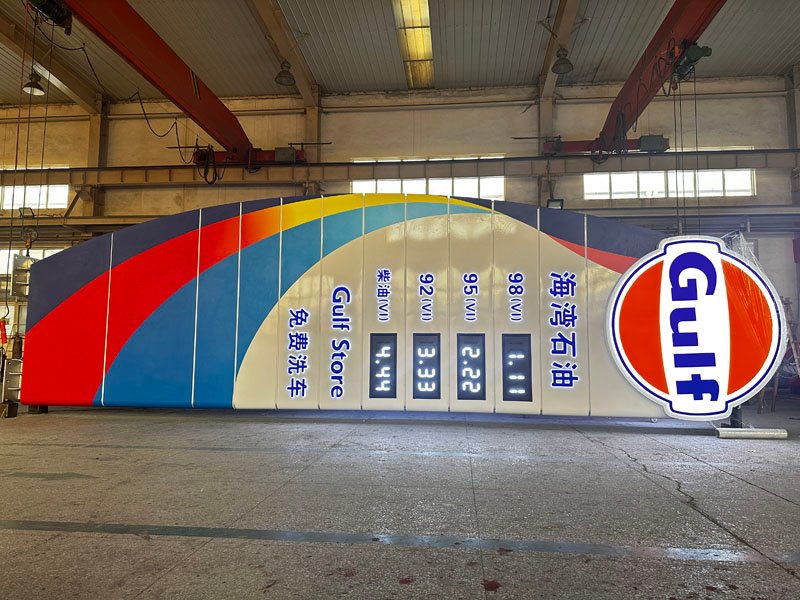


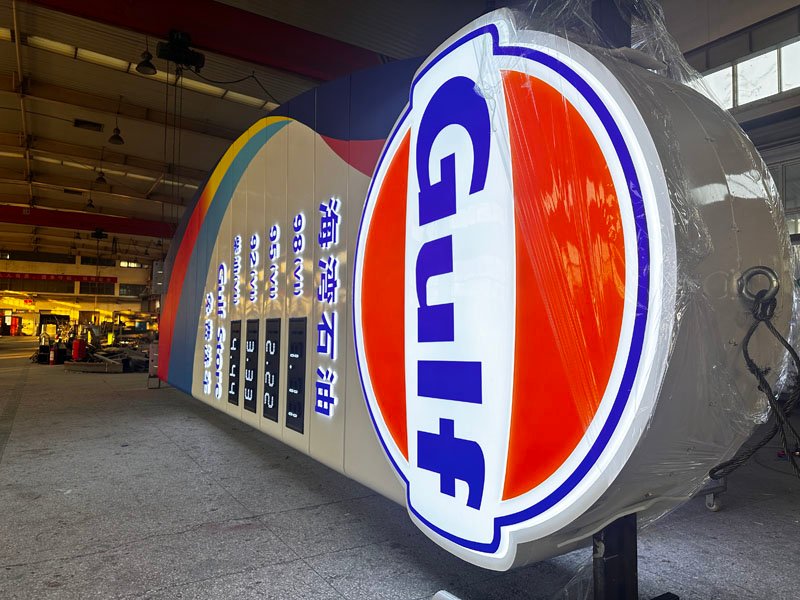
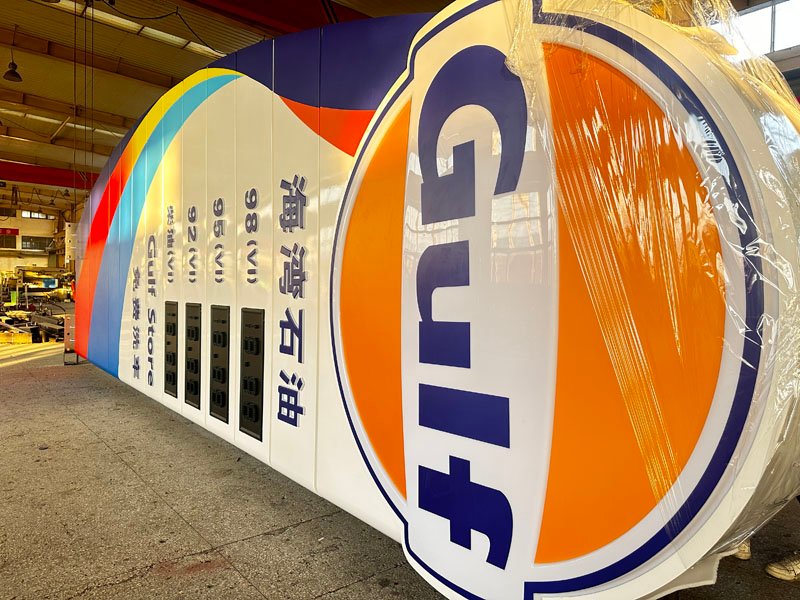

The gas station brand column light box is an important facility to showcase the brand image and attract customers’ attention. Its production process must take into account durability, aesthetics and night lighting effects.
Structural design
According to the site size of the gas station and the brand VI specification, determine the height (usually 6-12 meters), diameter (0.8-1.5 meters) and shape (cylindrical, polygonal, etc.) of the column light box.
It is necessary to consider the wind resistance level (generally designed according to the local maximum wind force, and coastal areas need to be strengthened), load-bearing capacity and foundation fixing method (embedded concrete or flange fixing).
Brand LOGO, color, text and other elements must comply with VI standards to ensure that they are clearly visible after being illuminated at night and avoid reflection or blur.
Design the light-transmitting area and light-shielding area of the light box panel to balance the aesthetics during the day and the lighting effect at night.
Main structure material
Steel: Q235 hot-rolled steel pipes or square pipes are commonly used for column frames. They are high in strength and moderate in cost. They need to be rust-proofed (galvanized or painted).
Aluminum alloy: Lightweight, corrosion-resistant, suitable for humid coastal environments, but with a higher cost. They are often used for panel frames or decorative parts.
Light box panel material
Acrylic sheet (PMMA): High light transmittance (85%-92%), strong weather resistance, suitable for long-term outdoor use, and can present patterns through UV printing or film.
Endurance sheet (PC sheet): Better impact resistance than acrylic, resistant to low temperatures, but slightly lower light transmittance (75%-85%), suitable for windy or collision-prone areas.
Lighting system materials
1. Light source: LED light strips or LED modules are mostly used, with low energy consumption and long life (more than 50,000 hours), and the color temperature is 3000K-6000K (warm white to pure white, adjusted according to the brand style).
2. Power supply: A waterproof power box is required to ensure safe operation in outdoor humid environments, with overload protection function.
Graphic printing / film
UV printing: Print the brand pattern directly on the panel surface, with bright colors and strong adhesion, suitable for complex patterns.
Film: Use outdoor special light-transmitting film (such as 3M light box film), which is resistant to UV aging, and the pattern can be changed at any time, with low cost.
Factory inspection
Test wind resistance (using a wind pressure tester to simulate strong winds), waterproof performance (check for water seepage after 24 hours of rain test), and lighting stability (light up continuously for 72 hours to observe for malfunctions).
Installation suggestions
Foundation construction: Pour the concrete foundation according to the design requirements (depth ≥1.5 meters, adjusted according to the geology), and embed the anchor bolts or flanges.
Hoisting and fixing: Use a crane to vertically install the light box column on the foundation, calibrate the verticality and tighten the bolts, and finally connect the power cord and test the overall function.
Maintenance and lifespan
Clean the panel regularly (every 3-6 months) to remove dust and oil to ensure light transmittance; check whether the circuit is aging and replace damaged LED light strips or power supplies in time.
Under normal use, the service life can reach 8-10 years, and the main consumables (light strips, sealants) need to be replaced every 3-5 years.